Author: Abbas Safari
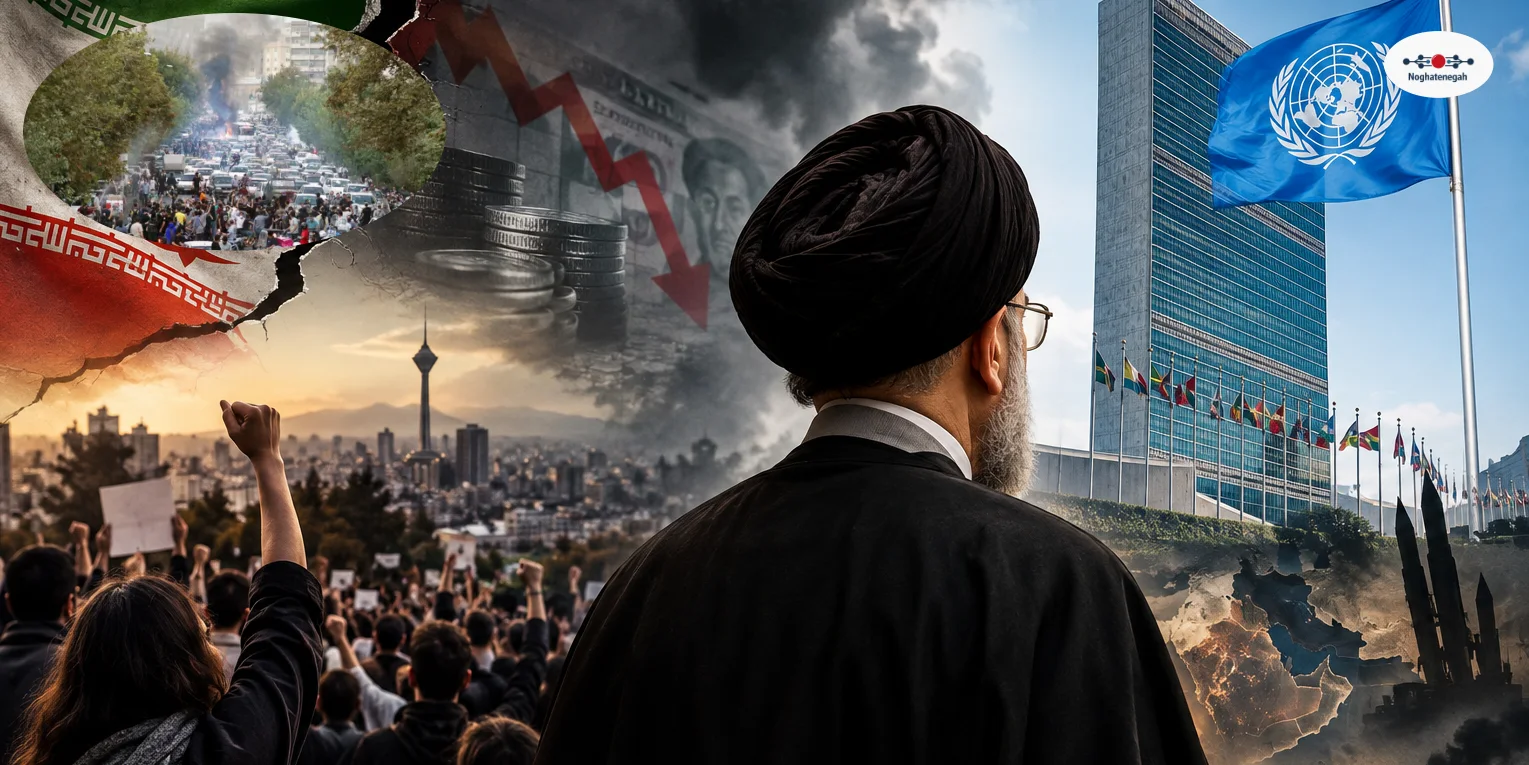
While the regime faces a host of deep-seated economic, social, and political crises domestically, its propaganda and diplomatic machinery continues to project an image of “power,” “resistance,” and defiance against the world—an image that stands in stark contrast to the reality of life for millions of Iranians.
A government facing internal protests, discontent, and a crisis of legitimacy—while simultaneously confronting numerous allegations and reports regarding arbitrary detentions, torture, violations of freedom of expression, and the use of the death penalty—persists in employing rhetoric of threat and confrontation on the international stage.
Recent reports by UN human rights bodies have also expressed concern regarding instances of arbitrary detention, enforced disappearances, torture, executions, and violations of fair trial standards in Iran.
This contradiction is a defining characteristic of the regime’s behaviour:
**the deeper the domestic crises become, the more pronounced the displays of power and the manufacturing of external crises.**
1: Domestic Repression, External Threats
Over the past decades, the regime has demonstrated its willingness to employ extensive security and judicial measures against dissidents and protesters to preserve its power structure.
From nationwide protests to crackdowns on political, civil, and human rights activists, numerous international reports have documented instances of detention, torture, restrictions on freedom of expression, and the use of the death penalty.
In 2026, UN human rights bodies also issued warnings to Iranian authorities regarding cases involving allegations of torture, arbitrary detention, and a lack of fair trial guarantees. In such a structure, rhetoric regarding “the rights of the nation” and “respect for human dignity” voiced by government officials—divorced from their actual track record—cannot serve as a valid yardstick for assessment.
The true benchmark is how the government treats its own citizens.
2: Projecting Power to Mask Weakness
One tactic employed by authoritarian and fascist regimes to manage domestic crises is to manufacture a foreign enemy and amplify external threats.
In Iran, too, a significant portion of official propaganda has long focused on confrontation with the United States, Israel, and the West.
This policy enables the government to sideline domestic issues and organise the political landscape around the narrative of an “external threat.”
However, economic crises cannot be resolved through slogans alone.
Inflation, declining purchasing power, corruption, inefficiency, emigration, unemployment, and social discontent are realities that do not vanish simply by holding international summits or delivering aggressive speeches.
If a government fails to address its people’s problems, projecting power abroad cannot indefinitely conceal its structural weaknesses at home.
3: Foreign Policy or a Tool for Survival?
Officials have frequently spoken of negotiation and diplomacy; yet, simultaneously, their regional policy has rested on supporting a network of proxy forces.
In its reports, the U.S. State Department has linked the Iranian government and the Islamic Revolutionary Guard Corps (IRGC) to the provision of financial, military, and training support for terrorist groups—including
Hezbollah, Hamas, the Houthis, and allied factions in Iraq and Syria.
From this perspective, the issue is not merely a dispute between two nations or a standard diplomatic conflict; rather, it concerns a policy with consequences that extend beyond Iran’s borders, impacting regional security and stability.
4: What Does Diplomacy Mean Without a Change in Behaviour?
Diplomacy can only become a tool for resolving a crisis if it leads to genuine changes in behaviour.
Negotiations used merely to alleviate pressure, buy time, or temporarily break out of isolation do not equate to resolving the crisis.
Therefore, the fundamental question is not whether or not to negotiate with the clerical regime.
The more important question is:
Negotiations aimed at what goal, and backed by what enforcement mechanisms?
If negotiations are to address the nuclear program, missile activities, support for terrorist groups, or human rights, the outcome must be measurable and verifiable.
5: Why is the policy of appeasement criticised?
Critics of the appeasement policy argue that granting concessions without imposing commensurate costs for repressive and destabilising actions sends a message to the regime that it can simultaneously engage in domestic repression and instigate crises abroad, while still reaping the benefits of diplomatic engagement and negotiation.
In recent years, the United States has also imposed sanctions targeting the Islamic Republic’s support for proxy groups, its oil revenues, and its human rights violations.
However, the experience with sanctions and negotiations demonstrates that no policy can be evaluated solely based on its label.
What matters is the policy’s objectives, the costs it imposes on the regime, its impact on the Iranian people, and whether it ultimately leads to a change in behaviour.
6: Who pays the price for the regime’s policies?
One of the most bitter aspects of foreign policy is that the cost of confrontation often falls—directly or indirectly—upon the Iranian people.
Sanctions, economic isolation, reduced investment, and regional tensions can make life harder for ordinary citizens;
…while the power structure attempts to attribute the political and economic costs of this situation to external factors.
At the same time, the Iranian people also bear the cost of repressive domestic policies.
Thus, an Iranian citizen may face a dual burden:
pressure stemming from the government’s domestic policies and pressure resulting from the consequences of its foreign policy.
This reality underscores, more than ever, the necessity of distinguishing between the “Iranian people” and the “ruling system.”
7: What should the international community demand?
If the international community’s goal is to de-escalate the crisis and uphold the rights of the Iranian people, its policy must not focus solely on security or nuclear agreements.
Human rights, freedom of expression, the right to peaceful assembly, the prohibition of torture, fair trial guarantees, and an end to the political use of the death penalty must also form part of the international community’s clear demands.
At the same time, any negotiations must be accompanied by specific criteria:
clear and measurable commitments;
an independent verification mechanism;
defined consequences for breaching commitments;
serious attention to the human rights situation;
prevention of the diversion of resources toward destabilising regional activities;
and a clear distinction between exerting pressure on the power structure and harming ordinary people.
8: The Iran issue is not merely a nuclear one.
Reducing the Iran crisis to a nuclear issue overlooks a significant portion of the problem. The Iran crisis is an interwoven web of issues: human rights, domestic repression, the economy, corruption, regional policy, the missile program, the activities of the Islamic Revolutionary Guard Corps (IRGC), and ties to terrorist groups.
Resolving one of these issues without addressing the others will not necessarily lead to a resolution of the overall crisis.
Therefore, if the international community intends to engage in negotiations, it must learn from past experiences and not rely merely on promises and statements.
9: The regime cannot substitute crisis management for governance indefinitely.
The government may manage domestic crises for a time through propaganda, repression, and an atmosphere of intimidation, but it cannot permanently eliminate the society’s real problems.
No speech at the United Nations can put food on the people’s tables.
No slogan of reform or change can restore lost freedoms.
And no external threat can answer the questions of a generation demanding a different future.
The core crisis is not merely a dispute with the United States or the West; the fundamental crisis is the rift between the power structure and Iranian society.
**Conclusion and Perspective of the Noghatenegah**
The clerical regime continues to project power on the international stage while facing domestic economic, social, and political crises, as well as serious allegations of human rights violations.
Externally, its policy of supporting terrorist groups and utilising proxy forces has been a primary focus of criticism from various governments.
Under these circumstances, diplomacy should not equate to granting concessions without securing verifiable commitments.
The international community can engage in dialogue with them; however, such dialogue must not mean turning a blind eye to the repression of the Iranian people, human rights violations, or destabilising regional policies.
The central issue is not the punishment of the Iranian people; The point is that the government’s conduct must not go without consequence.
Targeted pressure, accountability for human rights violations, cutting off funding for destabilising and terrorist activities, and support for the rights of the Iranian people can form the basis of a policy that distinguishes between the “Iranian people” and the “mullahs’ regime.”