
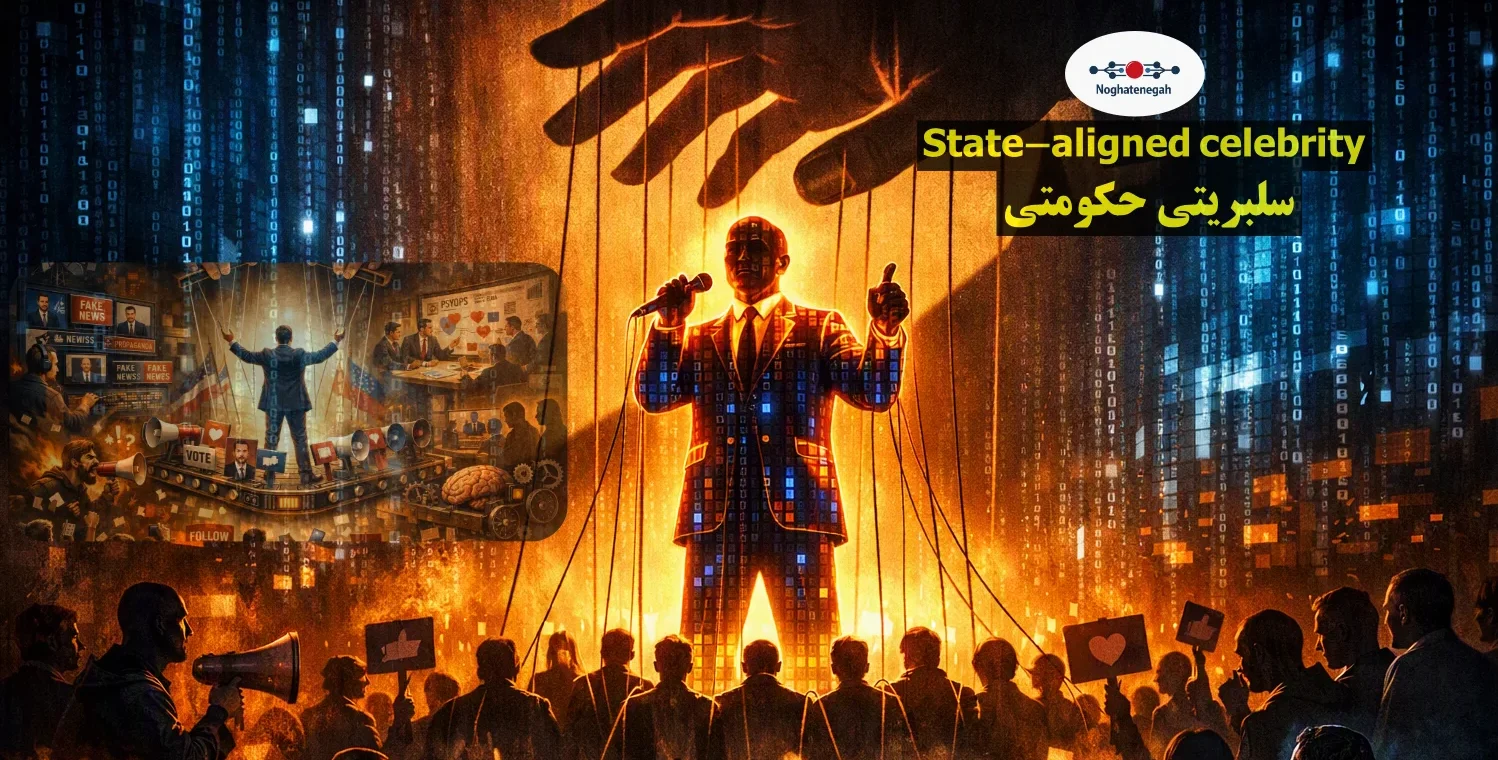
Author: Noghatenegah Editorial Team Political Celebrity-Making
Have you ever wondered why, during the most critical political and social crises, figures suddenly emerge offering ready-made solutions for almost every complex situation? Individuals who may have operated in completely unrelated fields yesterday, yet today speak with absolute certainty about economics, politics, national security, sociology, and the future of a country—often followed and reshared by millions.
This phenomenon cannot be attributed to a single cause. Part of it stems from the natural mechanics of social media, celebrity culture, and the public’s inclination toward simplified, personality-driven narratives. Research in the field of “celebrity politics” demonstrates that fame can become a tool for creating perceived authority and capturing political attention in digital spaces. But a more critical question arises: When does a figure’s popularity override expertise, evidence, and coherent planning?
In this episode of Noghatenegah, we unpack this exact mechanism—not to manufacture a new hero, nor to tear down any individual, but to analyse a structural system that shifts public consciousness away from evaluating core issues and toward blindly following personalities.Political Celebrity-Making
The Psychology of Political Celebrity Culture and the “Halo Effect”
Cognitive psychology defines a well-documented phenomenon known as the Halo Effect. According to the American Psychological Association (APA), the Halo Effect is a cognitive bias where our positive evaluation of a single prominent trait in an individual skews our overall judgment of their other, unrelated qualities.
For instance, an individual may be a successful actor, a celebrated athlete, a prominent musician, or an influential online figure. However, their success in one domain does not inherently grant them expertise in political science, economics, international law, national security, or sociology. Yet, during times of crisis, the human mind often erases these boundaries: “Because I admire this person and they excel in their field, their political analysis must also be correct.” In this manner, celebrity status transforms into a form of transferred credibility.
From Fame to Politics: When the “Face” Becomes the Message
Celebrity politics is not a new concept, but social media platforms have dramatically amplified its speed and reach. In the digital ecosystem, short video clips, emotionally charged quotes, and personal stories play a central role in constructing this perceived authority.
The problem emerges when personality replaces argument. In this environment, instead of asking, “What is the evidence?” “What is the source?”, or “What is the speaker’s expertise?”, the audience asks only one question: “Who said it?” If the answer is a beloved figure, popularity itself functions as a substitute for logical reasoning.Political Celebrity-Making
Analysing Claims: The Boundary Between Criticism and Propaganda
Here, we must draw a clear distinction. On one hand, political celebrity culture is a well-studied communication phenomenon. On the other hand, one cannot conclude that every popular figure or viral trend is strictly the product of an orchestrated “war room.” Claiming that a specific individual was intentionally engineered by a government or entity requires verifiable, empirical evidence.
Therefore, rather than hastily adopting conspiracy theories, we should pose a more precise question: Does a public figure’s message encourage the audience to think critically, or simply to follow them blindly?
A quote is sometimes attributed to Vladimir Lenin: “The best way to control the opposition is to lead it yourself.” While this quote cannot be definitively verified without primary source documentation, the underlying concept—that power structures attempt to influence opposition movements and manage emotional waves—remains a well-documented subject in political history.Political Celebrity-Making
Supporting the People of Iran: Human Rights Advocacy vs. Political Exploitation
The situation in Iran presents a complex illustration of this dilemma. On one hand, condemning executions and human rights violations in Iran is not merely a promotional topic; international organisations and the UN Fact-Finding Mission have documented extensive evidence in this regard. Official statements by various nations condemning human rights abuses represent professional and respectable positions.
On the other hand, the fact that a foreign government or political figure speaks in defence of human rights does not mean their entire political agenda should be accepted uncritically. One can defend a legitimate human rights stance without granting unlimited political leverage to any external entity or figurehead. Political Celebrity-Making
From False Hope to Disillusionment: The Cost of Hero Worship
One of the most damaging consequences of personality-driven politics is shifting intellectual responsibility from the individual citizen to a public figure. When a society repeatedly looks to an individual as a “saviour” or an “all-knowing leader,” any subsequent failure, contradiction, or lack of plan by that figure severely erodes public trust in the entire civic sphere.
The public inevitably concludes that “everyone is the same,” leading to cynicism and passive resignation rather than active, critical engagement.
What Is the Solution? Ending “Virtual Hero Worship”
The solution is not to banish public figures or celebrities from political discourse; every citizen has the right to express an opinion. The core issue arises when fame becomes a substitute for expertise. Social and political progress demands collective dialogue, accountable institutions, independent organisations, and specialised knowledge.Political Celebrity-Making
Before sharing or adopting the statements of a political figure or celebrity, we should ask these five essential questions:
Does the claim rely on verified sources and evidence?
Is the individual speaking within a domain where they possess demonstrable knowledge or experience?
Do they clearly distinguish between fact, analysis, and personal opinion?
Do they acknowledge past errors, contradictions, or gaps in their platform?
Does the speaker invite independent research, or do they demand unconditional trust?
The Goal Is Not to Select a New Hero
Political Celebrity-Making
At Noghatenegah, our objective is not to dictate who to follow or reject. Our purpose is to foster media literacy amidst a sea of noise and engineered narratives. We are not here to build new idols; neither governments, opposition figures, celebrities, nor media outlets are immune to critical scrutiny. A society that questions claims and demands evidence will always be resilient against manipulation.
Final Question:
In your view, what is the most prominent sign that an online figure is diverting public attention rather than raising genuine awareness? Share your thoughts rationally in the comments below.